Storms come through Blair County a few times a year and leave behind the same conversation: a tree comes down across the property line, half of it lands on one side, half on the other, and now nobody is sure who has to clean it up or pay for what.
The answer in Pennsylvania is usually clearer than people expect, but it depends on a few specific things. Here’s how it actually works.
Key Takeaways
- In Pennsylvania, ownership of a tree is based on where the trunk grows out of the ground, not where the branches reach.
- If a healthy tree falls in a storm, each property owner usually handles cleanup on their own side and files with their own insurance.
- If the tree was clearly dead, diseased, or hazardous and the owner knew, they can be held liable for damage to the neighbor.
- Homeowners insurance generally covers damage to structures, not just removal of a tree lying in the yard.
- Get photos, document the condition of the tree before and after, and talk to your insurer before paying anyone.
Step One: Who Owns the Tree?
In Pennsylvania, a tree belongs to the property owner whose land the trunk grows from. If the trunk straddles the line, it’s a boundary tree, and both owners share ownership and responsibility.
Branches and roots that extend over or under the line don’t change ownership. They belong to the owner of the trunk. A neighbor has the right to trim back what extends onto their side, up to the property line, as long as they don’t damage the tree itself or trespass to do it.
Step Two: Was the Tree Healthy or Hazardous?
This is the part that decides liability. Pennsylvania courts generally apply a reasonable-care standard:
- Healthy tree, act of nature: a healthy tree that comes down in a storm is treated as an act of God. The owner of the tree is usually not liable for damage on the neighbor’s side. Each side handles its own cleanup.
- Dead, dying, or obviously hazardous tree: if the tree was visibly dead, hollow, leaning, or had been flagged as a problem and the owner did nothing, the owner can be held liable for damage caused when it fell.
- Documented prior notice: if a neighbor sent a written request to remove a hazardous tree and the owner ignored it, that paper trail matters a lot if a claim ends up in court.
In practice, most fallen-tree claims in Blair County never get to court. They get sorted out through insurance. But the healthy-versus-hazardous question still drives which insurer pays.
Step Three: Where Did the Tree Land?
Once you know who owned it and whether it was healthy, the next question is where it ended up. This is what your insurance policy actually cares about:
Tree Lands on a Structure
If the tree hits a house, garage, shed, fence, deck, or car on Property A, the owner of Property A files a claim on their own homeowners or auto policy. Their insurance pays for the damage and usually pays for removing the part of the tree resting on the structure. It doesn’t matter whose tree it was, as long as the tree was healthy when it fell.
Insurance carriers may then go after the tree’s owner through subrogation if there’s evidence the tree was a known hazard. That’s the insurance companies’ problem, not yours directly.
Tree Lands in the Yard
If a tree falls and lands in the open yard without hitting anything, most standard policies do not cover removal of the wood. That’s typically the homeowner’s out-of-pocket cost. Some policies offer limited debris removal coverage (often $500 to $1,000) if the tree fell from wind or another covered peril, even if it didn’t hit a structure. Read your policy or ask your agent.
Tree Crosses the Property Line on the Ground
Each side owns and removes the wood on their side. That’s the standard expectation in Pennsylvania, again assuming the tree was healthy.
What About Power Lines?
If a fallen tree is on or near a power line, that’s not your problem to solve alone. Stay away from it. Call the utility (Penelec or your local provider) and let them de-energize and clear the line. Once the utility crew has handled the electrical side, a tree service can come in and finish the removal. We coordinate with utilities on these jobs across Blair County and Cambria County all the time.
What About Borough or Township Trees?
Some of the trees along streets in Altoona, Hollidaysburg, and other municipalities are technically in the public right-of-way and belong to the municipality, not the adjacent homeowner. If a street tree falls or is damaged, the municipality is usually responsible for removal. Call the borough or township office to confirm before you pay a contractor to take it down.
What You Should Do Right Now After a Tree Falls
- Make sure everyone is safe and away from any limbs that could still shift
- If a power line is involved, call the utility before anyone else
- Take photos from multiple angles before anything is moved
- Document the tree’s prior condition if you can (any earlier photos, dead branches visible, etc.)
- Call your homeowners insurance and open a claim if there is property damage
- Get an estimate from a licensed and insured tree service before signing anything
- If the tree came from a neighbor’s property and was clearly hazardous, share documentation with your insurer
How a Tree Service Helps in These Situations
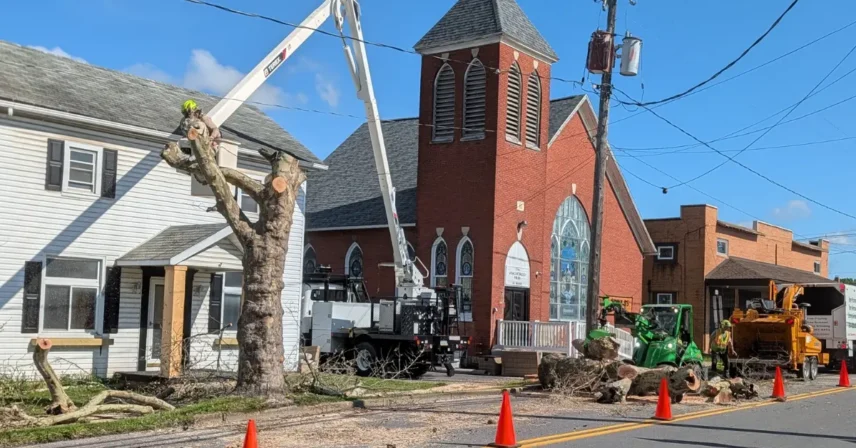
A good tree service does more than just cut wood. We document the job for your insurance carrier, separate cleanup by property line if needed, and coordinate with utilities and adjusters. Lofty Heights bills insurance directly on covered storm-damage jobs across Altoona and Blair County, which takes most of the paperwork off your plate.